DoingMaths - Free maths worksheets
  • Home
  • Algebra
    • Algebraic expressions
    • Algebraic equations
    • Expanding brackets
    • Index notation
    • Inequalities
    • Quadratic equations
    • Sequences
    • Simultaneous equations
    • Straight line graphs
    • Substitution
  • Shapes, space and measures
    • Angles
    • Circles
    • Circle theorems
    • Compound measures
    • Construction
    • Distance/speed-time graphs
    • Length, area and volume
    • Metric and Imperial conversions
    • Metric units of measurement
    • Proof
    • Pythagoras' Theorem
    • Scale factors, similarity and congruence
    • Symmetry and reflection
    • Time
    • Trigonometry
  • Number
    • Primary Addition and Subtraction
    • Addition and subtraction
    • Basic number work
    • BODMAS/PEMDAS/BIDMAS
    • Compound percentage change
    • Decimals
    • Factors and Multiples
    • Fractions
    • Fractions, decimals and percentages
    • Money
    • Multiplication and division
    • Percentages
    • Ratio and Proportion
    • Rounding and estimating
    • Standard form
  • Statistics and Probability
    • Averages and the Range
    • Box plots
    • Collecting data
    • Pie charts
    • Probability
  • More
    • Starters >
      • Puzzles and riddles
      • Maths Wordsearches
      • More Maths Lesson Starter Ideas
    • Christmas Maths Activities
    • Maths Articles >
      • Revision and How-To Guides >
        • How do Scale Factors Work for Area and Volume?
        • Edexcel GCSE Maths 2023 Paper 2: The Final Question
        • How to Find the Average From a Frequency Table
        • What Do the Angles in a Polygon Add Up To?
        • How to Integrate by Parts: Calculus Help
        • How to Use Pythagoras' Theorem
        • How to Calculate Compound Percentage Changes
        • How to Find Equivalent Fractions
        • How to Find the Averages and Range From Grouped Data
        • How to Factorise a Quadratic Algebraic Equation
        • How to Expand a Pair of Brackets
        • How to Complete the Square
        • Hannah's Sweets - Tricky GCSE Question
        • Why Do We Rationalise the Denominator?
        • How to Add, Subtract, Multiply and Divide Fractions
        • How to Answer the 'Impossible' Question on the Edexcel GCSE Maths Paper 2022
        • How to draw pie charts
        • How to Differentiate From First Principles
        • How to Solve Direct Proportion Questions
        • How to Calculate a Percentage of an Amount Using a Decimal Multiplier
      • How Many Gifts Do I Get Over the Twelve Days of Christmas?
      • How to Find the Sum of a Geometric Sequence
      • The Maths Behind A4 Paper
      • The Monty Hall Problem
      • Rationalizing the Denominator
      • How Do Binary Numbers Work?
      • Rice on a Chessboard
      • How to Prove Pi Equals 2
      • What is the Maximum Score in Ten-Pin Bowling?
      • The Prisoner's Dilemma
      • How Many Socks Make a Pair?
      • Four Interesting Types of Mathematical Numbers
      • How to Add the Numbers 1-100 Quickly
      • What Is the Sum of the Sequence 1, 1/2, 1/4, 1/8, 1/16, ...?
      • Find the Answer to 8×9×10×11×12 Without Using a Calculator
      • How to Prove that the Square root of 2 is Irrational
      • Three Interesting Fractals From Koch, Sierpinski and Cantor
      • How Many Squares Are on a Chessboard?
      • Different Kinds of Prime Numbers
      • How to Do Long Multiplication Using Napier's Method
      • The Handshake Problem
      • Why You Should Always Order the Large Pizza
      • Maximizing the Area of a Rectangle
      • Speed Arithmetic - How to Multiply by 11 Without a Calculator
      • Speed Arithmetic - How to Multiply and Divide by 5 Without a Calculator
      • Pythagoras' Theorem - A Proof
      • How Large Is Infinity?
      • Interesting Facts About Pascal's Triangle
      • Why Does Time Slow Down as You Approach the Speed of Light?
      • Five of History's Most Influential Women in STEM
      • Five More of History's Most Influential Women in STEM
      • How Likely Are You to Hit the Centre of the Archery Target?
      • Find Four Primes Smaller Than 100 Which Are Factors Of 3^32 − 2^32
      • Bertrand's Paradox: A Problem in Probability Theory
      • What Is an Erdős Number?
      • Three of Isaac Newton's Most Important Contributions to the World
      • Mathematical Numbers: What Is 'e'?
      • Hilbert's Paradox of the Grand Hotel: Another Look at Infinity
      • Decreasing the Circumference of Differently Sized Circles: A Counterintuitive Cricket Problem
      • Zeno's Paradox: Achilles and the Tortoise
      • What Are Hexadecimal Numbers?
      • Why Do We Split a Circle Into 360 Degrees?
      • N-bonacci Sequences - Taking Fibonacci Further
      • Being Careful When You Average an Average: A Basketball Problem
      • What Is a Dudeney Number?
    • A-Level Maths Paper Walkthroughs >
      • A-Level Maths, Edexcel, June 2018, Paper Walkthroughs >
        • A-Level Maths, June 2018, Pure Paper 1 Question Walkthroughs
        • A-Level Maths, June 2018, Pure Paper 2, Question Walkthroughs
        • A-Level Maths, June 2018, Statistics and Mechanics, Question Walkthroughs
      • A-Level Maths, Edexcel, June 2019, Paper Walkthroughs >
        • A-Level Maths, June 2019, Pure Paper 1, Question Walkthroughs
        • A-Level Maths, June 2019, Pure Paper 2, Question Walkthrough
        • A-Level Maths, June 2019, Statistics and Mechanics, Walkthrough answers
      • A-Level Maths, Edexcel, October 2020, Paper Walkthroughs >
        • A-Level Maths, October 2020, Pure Mathematics Paper 1, Question Walkthroughs
        • A-Level Maths, October 2020, Pure Mathematics Paper 2, Question Walkthroughs
        • A-Level Maths, October 2020, Statistics and Mechanics, Walkthrough answers
      • A-Level Maths, Edexcel, October 2021, Paper Walkthroughs >
        • A-Level Maths, October 2021, Pure Mathematics, Paper 1 Walkthroughs
        • A-Level Maths, October 2021, Pure Mathematics Paper 2 Walkthroughs
        • A-Level Maths, October 2021, Statistics and Mechanics, Walkthrough answers
      • A-Level Maths, Edexcel, June 2022, Paper 1 Walkthroughs
    • Mathematician of the Month
    • Tricky Geometry Problems
    • DoingMaths video channel
    • DoingMaths Shop
    • Contact us
    • Privacy policy

More Maths Lesson Starter Ideas

On this page, you can find more ideas for quick easy maths starters deigned to get your class in and focussed.
Number of the day maths starter worksheet
Number of the day worksheet

Number of the Day Worksheet

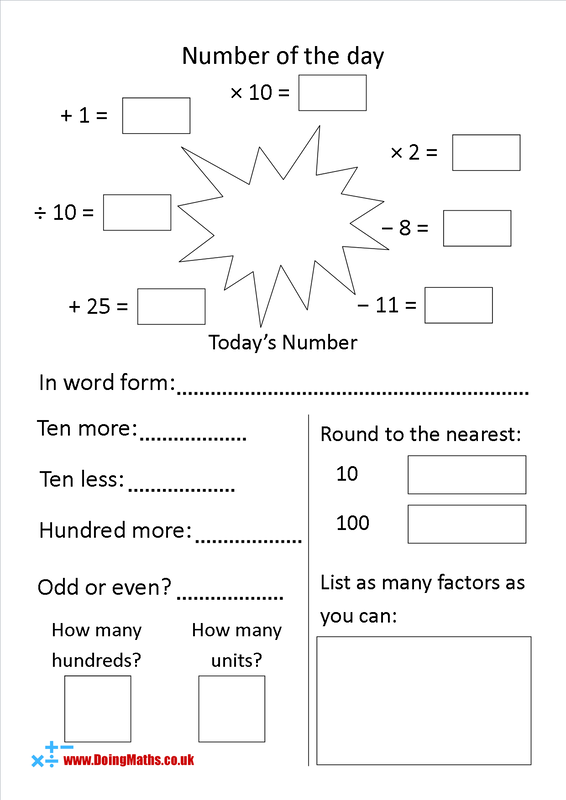
Designed as a maths lesson starter activity, this worksheet is great for getting your students to practise their basic number skills.
Choose a 3 or 4 digit number as your number of the day. Your students write this number in the star and then complete the questions around the page.
Skills used include addition, subtraction, multiplication, rounding, finding factors and recognising place value.
number_of_the_day_worksheet.pdf
File Size: 400 kb
File Type: pdf
Download File

Multiplication grid starter

Multiplication Grid Starter

The aim of this multiplication grid starter is to fill in each of the inner squares with the product of the squares at the top and left. e.g. the top left blank square in the picture would be 3x4 = 12, the one below it would be 8x4 = 32 etc.
The spreadsheet is designed to print out 5 pairs of grids on one sheet of A4. If the numbers in the top grids are changed, the changes will also appear in the other grids too.
multiplication_grid_starter.xlsx
File Size: 12 kb
File Type: xlsx
Download File


Editable multiplication starter

Editable Multiplication Starter

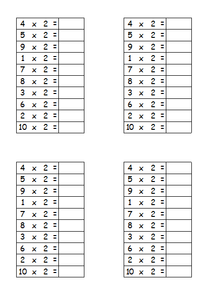
On this fully editable Excel worksheet, whenever the second value in the top left question is altered, the rest of the second values also change. Great for practising particular times tables.
multiplication_starter.xlsx
File Size: 10 kb
File Type: xlsx
Download File

Picture

Fill in the Grid starter

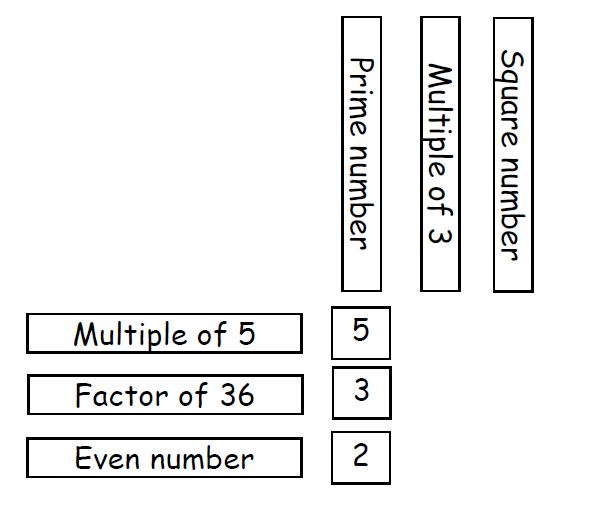
This starter activity comes complete with ten different categories of numbers such as 'Prime number' and 'Multiple of 3', and the numbers 1-25.
The aim of the puzzle is to arrange six of the categories into a 3x3 grid, where the categories describe the types of number allowed in that row or column.
Not all combinations of category can be completed, part of the skill is to select the correct ones. 
fill_in_the_grid.pdf
File Size: 86 kb
File Type: pdf
Download File

Free maths lesson starter activities

Home      Algebra      Shapes, space and measures      Number      Data handling      Starters      Internet articles      DoingMaths Youtube channel
© Copyright DoingMaths free worksheets 2026 - All Rights Reserved
  • Home
  • Algebra
    • Algebraic expressions
    • Algebraic equations
    • Expanding brackets
    • Index notation
    • Inequalities
    • Quadratic equations
    • Sequences
    • Simultaneous equations
    • Straight line graphs
    • Substitution
  • Shapes, space and measures
    • Angles
    • Circles
    • Circle theorems
    • Compound measures
    • Construction
    • Distance/speed-time graphs
    • Length, area and volume
    • Metric and Imperial conversions
    • Metric units of measurement
    • Proof
    • Pythagoras' Theorem
    • Scale factors, similarity and congruence
    • Symmetry and reflection
    • Time
    • Trigonometry
  • Number
    • Primary Addition and Subtraction
    • Addition and subtraction
    • Basic number work
    • BODMAS/PEMDAS/BIDMAS
    • Compound percentage change
    • Decimals
    • Factors and Multiples
    • Fractions
    • Fractions, decimals and percentages
    • Money
    • Multiplication and division
    • Percentages
    • Ratio and Proportion
    • Rounding and estimating
    • Standard form
  • Statistics and Probability
    • Averages and the Range
    • Box plots
    • Collecting data
    • Pie charts
    • Probability
  • More
    • Starters >
      • Puzzles and riddles
      • Maths Wordsearches
      • More Maths Lesson Starter Ideas
    • Christmas Maths Activities
    • Maths Articles >
      • Revision and How-To Guides >
        • How do Scale Factors Work for Area and Volume?
        • Edexcel GCSE Maths 2023 Paper 2: The Final Question
        • How to Find the Average From a Frequency Table
        • What Do the Angles in a Polygon Add Up To?
        • How to Integrate by Parts: Calculus Help
        • How to Use Pythagoras' Theorem
        • How to Calculate Compound Percentage Changes
        • How to Find Equivalent Fractions
        • How to Find the Averages and Range From Grouped Data
        • How to Factorise a Quadratic Algebraic Equation
        • How to Expand a Pair of Brackets
        • How to Complete the Square
        • Hannah's Sweets - Tricky GCSE Question
        • Why Do We Rationalise the Denominator?
        • How to Add, Subtract, Multiply and Divide Fractions
        • How to Answer the 'Impossible' Question on the Edexcel GCSE Maths Paper 2022
        • How to draw pie charts
        • How to Differentiate From First Principles
        • How to Solve Direct Proportion Questions
        • How to Calculate a Percentage of an Amount Using a Decimal Multiplier
      • How Many Gifts Do I Get Over the Twelve Days of Christmas?
      • How to Find the Sum of a Geometric Sequence
      • The Maths Behind A4 Paper
      • The Monty Hall Problem
      • Rationalizing the Denominator
      • How Do Binary Numbers Work?
      • Rice on a Chessboard
      • How to Prove Pi Equals 2
      • What is the Maximum Score in Ten-Pin Bowling?
      • The Prisoner's Dilemma
      • How Many Socks Make a Pair?
      • Four Interesting Types of Mathematical Numbers
      • How to Add the Numbers 1-100 Quickly
      • What Is the Sum of the Sequence 1, 1/2, 1/4, 1/8, 1/16, ...?
      • Find the Answer to 8×9×10×11×12 Without Using a Calculator
      • How to Prove that the Square root of 2 is Irrational
      • Three Interesting Fractals From Koch, Sierpinski and Cantor
      • How Many Squares Are on a Chessboard?
      • Different Kinds of Prime Numbers
      • How to Do Long Multiplication Using Napier's Method
      • The Handshake Problem
      • Why You Should Always Order the Large Pizza
      • Maximizing the Area of a Rectangle
      • Speed Arithmetic - How to Multiply by 11 Without a Calculator
      • Speed Arithmetic - How to Multiply and Divide by 5 Without a Calculator
      • Pythagoras' Theorem - A Proof
      • How Large Is Infinity?
      • Interesting Facts About Pascal's Triangle
      • Why Does Time Slow Down as You Approach the Speed of Light?
      • Five of History's Most Influential Women in STEM
      • Five More of History's Most Influential Women in STEM
      • How Likely Are You to Hit the Centre of the Archery Target?
      • Find Four Primes Smaller Than 100 Which Are Factors Of 3^32 − 2^32
      • Bertrand's Paradox: A Problem in Probability Theory
      • What Is an Erdős Number?
      • Three of Isaac Newton's Most Important Contributions to the World
      • Mathematical Numbers: What Is 'e'?
      • Hilbert's Paradox of the Grand Hotel: Another Look at Infinity
      • Decreasing the Circumference of Differently Sized Circles: A Counterintuitive Cricket Problem
      • Zeno's Paradox: Achilles and the Tortoise
      • What Are Hexadecimal Numbers?
      • Why Do We Split a Circle Into 360 Degrees?
      • N-bonacci Sequences - Taking Fibonacci Further
      • Being Careful When You Average an Average: A Basketball Problem
      • What Is a Dudeney Number?
    • A-Level Maths Paper Walkthroughs >
      • A-Level Maths, Edexcel, June 2018, Paper Walkthroughs >
        • A-Level Maths, June 2018, Pure Paper 1 Question Walkthroughs
        • A-Level Maths, June 2018, Pure Paper 2, Question Walkthroughs
        • A-Level Maths, June 2018, Statistics and Mechanics, Question Walkthroughs
      • A-Level Maths, Edexcel, June 2019, Paper Walkthroughs >
        • A-Level Maths, June 2019, Pure Paper 1, Question Walkthroughs
        • A-Level Maths, June 2019, Pure Paper 2, Question Walkthrough
        • A-Level Maths, June 2019, Statistics and Mechanics, Walkthrough answers
      • A-Level Maths, Edexcel, October 2020, Paper Walkthroughs >
        • A-Level Maths, October 2020, Pure Mathematics Paper 1, Question Walkthroughs
        • A-Level Maths, October 2020, Pure Mathematics Paper 2, Question Walkthroughs
        • A-Level Maths, October 2020, Statistics and Mechanics, Walkthrough answers
      • A-Level Maths, Edexcel, October 2021, Paper Walkthroughs >
        • A-Level Maths, October 2021, Pure Mathematics, Paper 1 Walkthroughs
        • A-Level Maths, October 2021, Pure Mathematics Paper 2 Walkthroughs
        • A-Level Maths, October 2021, Statistics and Mechanics, Walkthrough answers
      • A-Level Maths, Edexcel, June 2022, Paper 1 Walkthroughs
    • Mathematician of the Month
    • Tricky Geometry Problems
    • DoingMaths video channel
    • DoingMaths Shop
    • Contact us
    • Privacy policy