DoingMaths - Free maths worksheets
  • Home
  • Algebra
    • Algebraic expressions
    • Algebraic equations
    • Expanding brackets
    • Index notation
    • Inequalities
    • Quadratic equations
    • Sequences
    • Simultaneous equations
    • Straight line graphs
    • Substitution
  • Shapes, space and measures
    • Angles
    • Circles
    • Circle theorems
    • Compound measures
    • Construction
    • Distance/speed-time graphs
    • Length, area and volume
    • Metric and Imperial conversions
    • Metric units of measurement
    • Proof
    • Pythagoras' Theorem
    • Scale factors, similarity and congruence
    • Symmetry and reflection
    • Time
    • Trigonometry
  • Number
    • Primary Addition and Subtraction
    • Addition and subtraction
    • Basic number work
    • BODMAS/PEMDAS/BIDMAS
    • Compound percentage change
    • Decimals
    • Factors and Multiples
    • Fractions
    • Fractions, decimals and percentages
    • Money
    • Multiplication and division
    • Percentages
    • Ratio and Proportion
    • Rounding and estimating
    • Standard form
  • Statistics and Probability
    • Averages and the Range
    • Box plots
    • Collecting data
    • Pie charts
    • Probability
  • More
    • Starters >
      • Puzzles and riddles
      • Maths Wordsearches
      • More Maths Lesson Starter Ideas
    • Christmas Maths Activities
    • Maths Articles >
      • Revision and How-To Guides >
        • How do Scale Factors Work for Area and Volume?
        • Edexcel GCSE Maths 2023 Paper 2: The Final Question
        • How to Find the Average From a Frequency Table
        • What Do the Angles in a Polygon Add Up To?
        • How to Integrate by Parts: Calculus Help
        • How to Use Pythagoras' Theorem
        • How to Calculate Compound Percentage Changes
        • How to Find Equivalent Fractions
        • How to Find the Averages and Range From Grouped Data
        • How to Factorise a Quadratic Algebraic Equation
        • How to Expand a Pair of Brackets
        • How to Complete the Square
        • Hannah's Sweets - Tricky GCSE Question
        • Why Do We Rationalise the Denominator?
        • How to Add, Subtract, Multiply and Divide Fractions
        • How to Answer the 'Impossible' Question on the Edexcel GCSE Maths Paper 2022
        • How to draw pie charts
        • How to Differentiate From First Principles
        • How to Solve Direct Proportion Questions
        • How to Calculate a Percentage of an Amount Using a Decimal Multiplier
      • How Many Gifts Do I Get Over the Twelve Days of Christmas?
      • How to Find the Sum of a Geometric Sequence
      • The Maths Behind A4 Paper
      • The Monty Hall Problem
      • Rationalizing the Denominator
      • How Do Binary Numbers Work?
      • Rice on a Chessboard
      • How to Prove Pi Equals 2
      • What is the Maximum Score in Ten-Pin Bowling?
      • The Prisoner's Dilemma
      • How Many Socks Make a Pair?
      • Four Interesting Types of Mathematical Numbers
      • How to Add the Numbers 1-100 Quickly
      • What Is the Sum of the Sequence 1, 1/2, 1/4, 1/8, 1/16, ...?
      • Find the Answer to 8×9×10×11×12 Without Using a Calculator
      • How to Prove that the Square root of 2 is Irrational
      • Three Interesting Fractals From Koch, Sierpinski and Cantor
      • How Many Squares Are on a Chessboard?
      • Different Kinds of Prime Numbers
      • How to Do Long Multiplication Using Napier's Method
      • The Handshake Problem
      • Why You Should Always Order the Large Pizza
      • Maximizing the Area of a Rectangle
      • Speed Arithmetic - How to Multiply by 11 Without a Calculator
      • Speed Arithmetic - How to Multiply and Divide by 5 Without a Calculator
      • Pythagoras' Theorem - A Proof
      • How Large Is Infinity?
      • Interesting Facts About Pascal's Triangle
      • Why Does Time Slow Down as You Approach the Speed of Light?
      • Five of History's Most Influential Women in STEM
      • Five More of History's Most Influential Women in STEM
      • How Likely Are You to Hit the Centre of the Archery Target?
      • Find Four Primes Smaller Than 100 Which Are Factors Of 3^32 − 2^32
      • Bertrand's Paradox: A Problem in Probability Theory
      • What Is an Erdős Number?
      • Three of Isaac Newton's Most Important Contributions to the World
      • Mathematical Numbers: What Is 'e'?
      • Hilbert's Paradox of the Grand Hotel: Another Look at Infinity
      • Decreasing the Circumference of Differently Sized Circles: A Counterintuitive Cricket Problem
      • Zeno's Paradox: Achilles and the Tortoise
      • What Are Hexadecimal Numbers?
      • Why Do We Split a Circle Into 360 Degrees?
      • N-bonacci Sequences - Taking Fibonacci Further
      • Being Careful When You Average an Average: A Basketball Problem
      • What Is a Dudeney Number?
    • A-Level Maths Paper Walkthroughs >
      • A-Level Maths, Edexcel, June 2018, Paper Walkthroughs >
        • A-Level Maths, June 2018, Pure Paper 1 Question Walkthroughs
        • A-Level Maths, June 2018, Pure Paper 2, Question Walkthroughs
        • A-Level Maths, June 2018, Statistics and Mechanics, Question Walkthroughs
      • A-Level Maths, Edexcel, June 2019, Paper Walkthroughs >
        • A-Level Maths, June 2019, Pure Paper 1, Question Walkthroughs
        • A-Level Maths, June 2019, Pure Paper 2, Question Walkthrough
        • A-Level Maths, June 2019, Statistics and Mechanics, Walkthrough answers
      • A-Level Maths, Edexcel, October 2020, Paper Walkthroughs >
        • A-Level Maths, October 2020, Pure Mathematics Paper 1, Question Walkthroughs
        • A-Level Maths, October 2020, Pure Mathematics Paper 2, Question Walkthroughs
        • A-Level Maths, October 2020, Statistics and Mechanics, Walkthrough answers
      • A-Level Maths, Edexcel, October 2021, Paper Walkthroughs >
        • A-Level Maths, October 2021, Pure Mathematics, Paper 1 Walkthroughs
        • A-Level Maths, October 2021, Pure Mathematics Paper 2 Walkthroughs
        • A-Level Maths, October 2021, Statistics and Mechanics, Walkthrough answers
      • A-Level Maths, Edexcel, June 2022, Paper 1 Walkthroughs
    • Mathematician of the Month
    • Tricky Geometry Problems
    • DoingMaths video channel
    • DoingMaths Shop
    • Contact us
    • Privacy policy

Primary Addition and Subtraction - Free worksheets and other resources

The foundation of school maths, arithmetic is something many children struggle with. Giving a child a good foundation with numbers will make the rest of school maths so much easier. Here we have resources dealing with addition and subtraction of whole numbers to help embed these key skills.

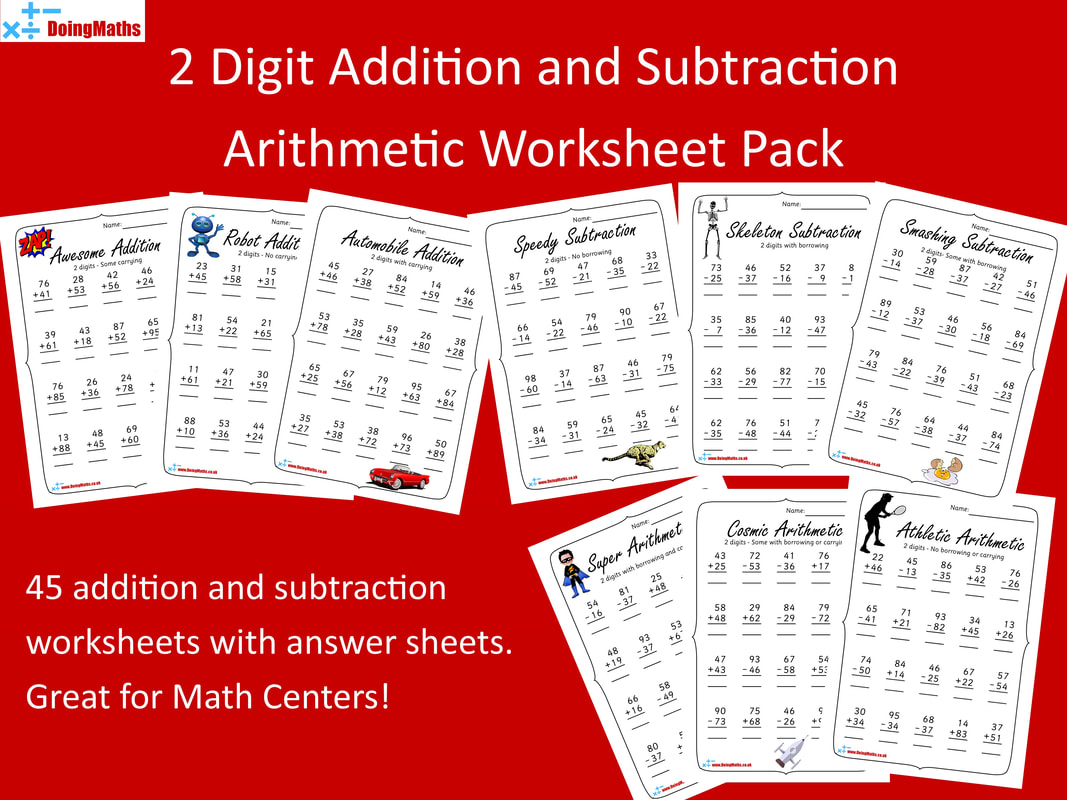
2-digit addition and subtraction worksheet pack
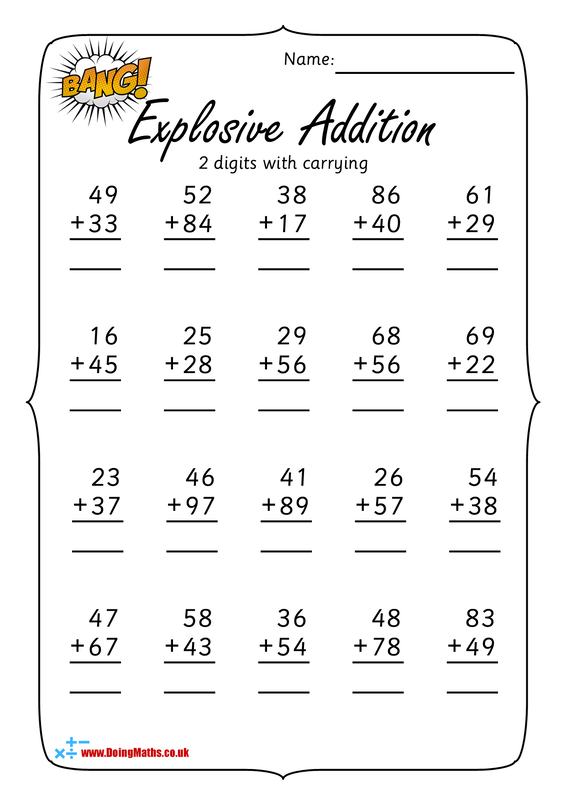
2 digit addition worksheet with carrying
A set of 3 printable worksheets for practising 2-digit addition and subtraction.
This pack includes one worksheet on addition with carrying, one worksheet on subtraction without borrowing and one worksheet featuring both addition and subtraction with some borrowing and carrying.
​Ideal for maths centres, lesson warm-ups or quick summative assessments.
2_digit_arithmetic_worksheets_pack_sample.pdf
File Size: 599 kb
File Type: pdf
Download File

2 digit addition and subtraction worksheet bundle
This worksheet is part of a 45 page collection available now from Teacherspayteachers for only $4.99.


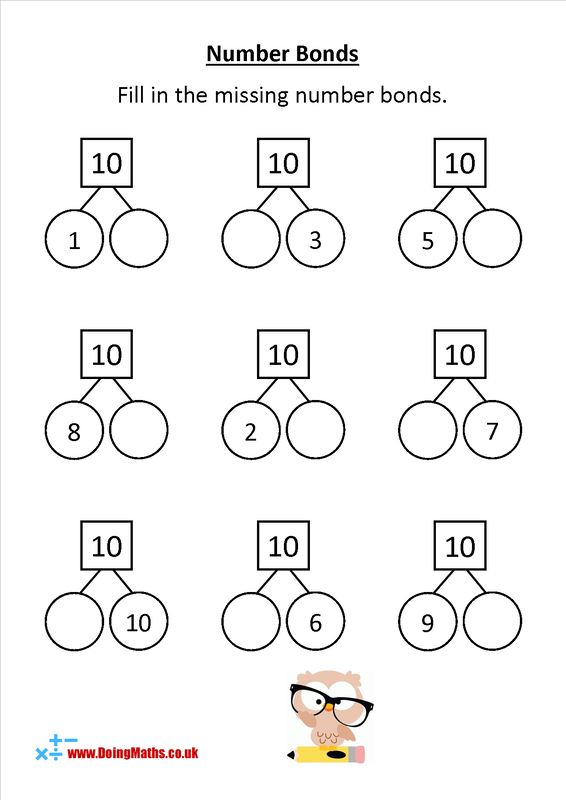
Number bonds to 10 worksheet
Number bonds to ten worksheet

Number bonds to ten worksheet

Practise those invaluable number bonds to ten with this worksheet. If a student knows those number bonds instantly, it makes more complicated arithmetic much simpler.
number_bonds_to_ten.pdf
File Size: 418 kb
File Type: pdf
Download File

number_bonds_to_ten_-_answer_sheet.pdf
File Size: 420 kb
File Type: pdf
Download File

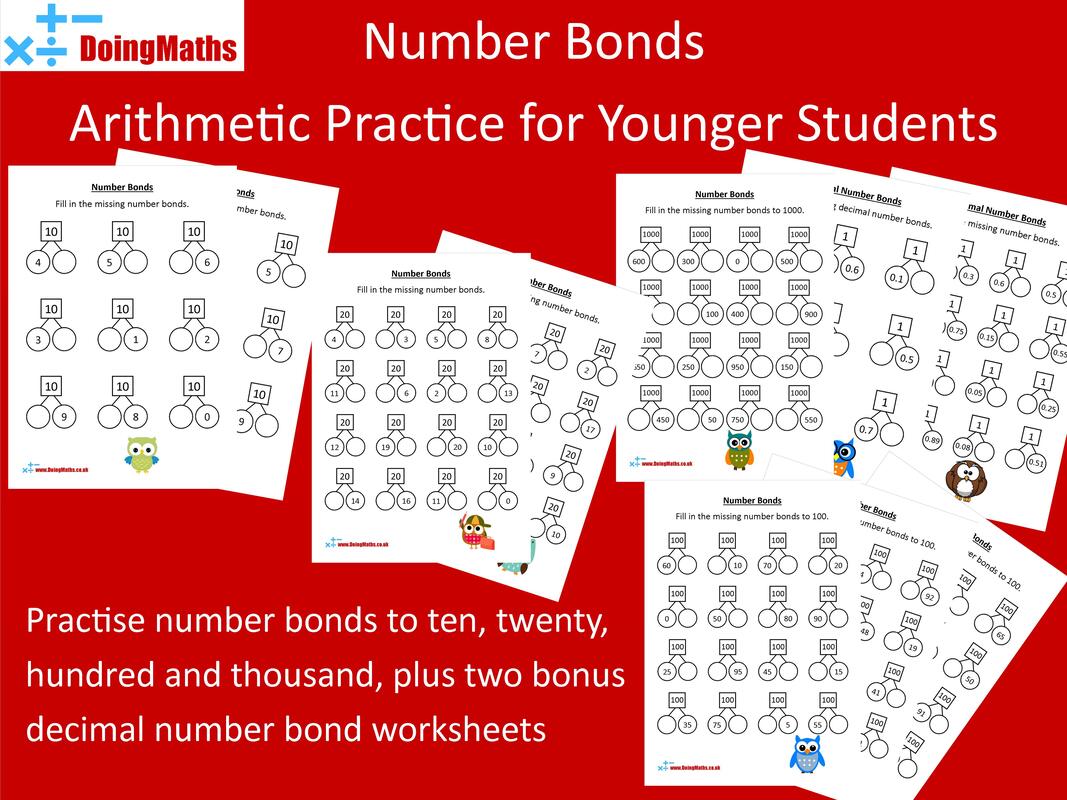
Number bonds arithmetic practice worksheets
This worksheet is part of a ten page collection available now from Teacherspayteachers for only $2.50.

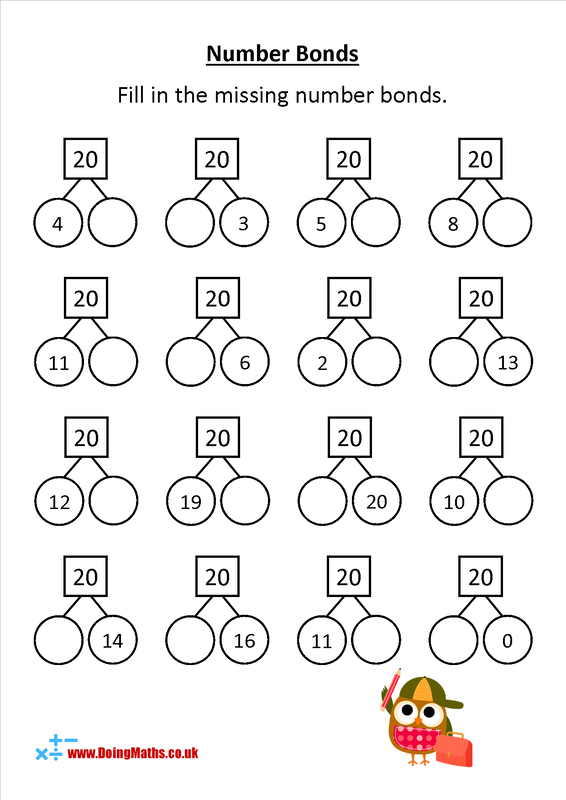
Number bonds to 20 free maths worksheet
Number bonds to 20 worksheet

Number bonds to 20 worksheet

A follow up to the number bonds to 10 worksheet, this one is great practice for those slightly trickier number bonds to 20.
number_bonds_to_twenty.pdf
File Size: 464 kb
File Type: pdf
Download File

number_bonds_to_twenty_-_answer_sheet.pdf
File Size: 465 kb
File Type: pdf
Download File


Arithmetic practice riddles

Arithmetic practice riddles

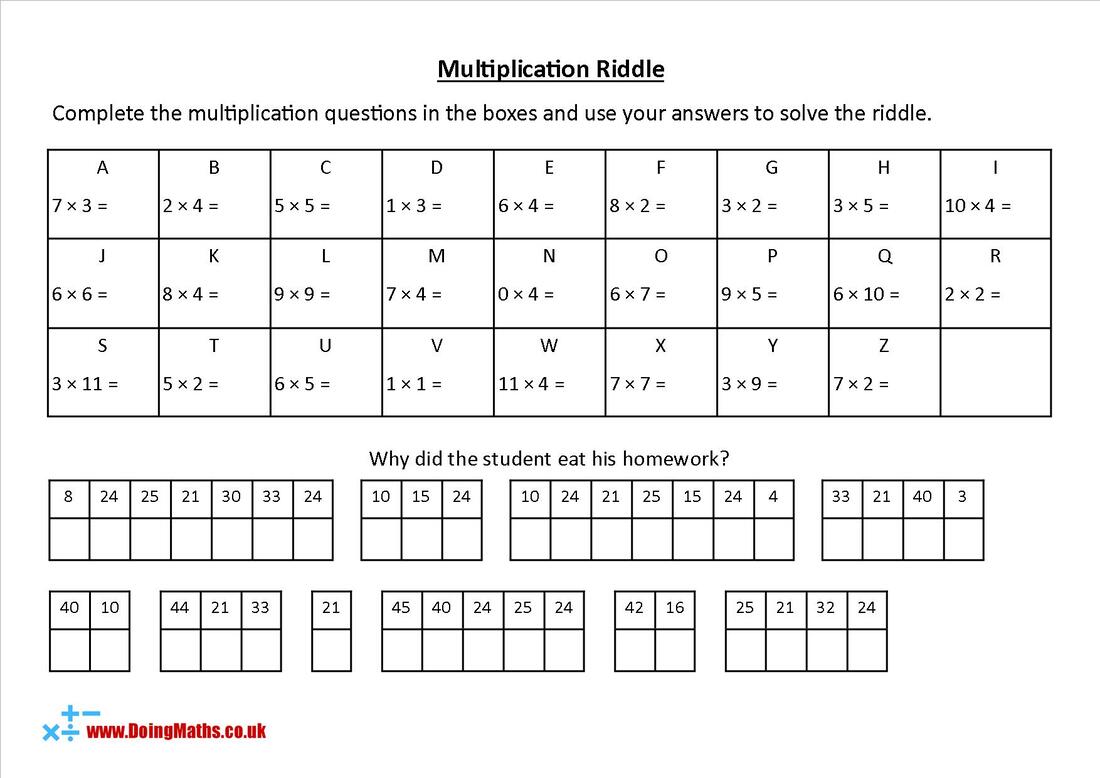
These arithmetic practice worksheets involve solving the sums to reveal the answer to the riddle.
Available for multiplication, addition, subtraction or mixed operation arithmetic, these can be downloaded from the TES Resource site.

Picture

Primary Addition Question Trail - Treasure Hunt

A fun, active way to practise addition in the classroom!
​Answer each addition question to find the next question on the trail. Keep going until you have answered all of the questions.
Further Maths question trails are available to purchase from DoingMaths on TPT.
treasure_hunt_addition.pdf
File Size: 467 kb
File Type: pdf
Download File


Primary subtraction question trail treasure hunt

Primary Subtraction Question Trail - Treasure Hunt

A hands-on approach to practising simple subtraction questions.
​Answer each take-away question to find the next question on the trail. Keep going until you have answered all of the questions.
More maths question trails are available to purchase from DoingMaths on TPT.
treasure_hunt_subtraction.pdf
File Size: 468 kb
File Type: pdf
Download File

Free primary school addition and subtraction maths worksheets

Home      Algebra      Shapes, space and measures      Number      Data handling      Starters      Internet articles      DoingMaths Youtube channel
© Copyright DoingMaths free worksheets 2026 - All Rights Reserved
  • Home
  • Algebra
    • Algebraic expressions
    • Algebraic equations
    • Expanding brackets
    • Index notation
    • Inequalities
    • Quadratic equations
    • Sequences
    • Simultaneous equations
    • Straight line graphs
    • Substitution
  • Shapes, space and measures
    • Angles
    • Circles
    • Circle theorems
    • Compound measures
    • Construction
    • Distance/speed-time graphs
    • Length, area and volume
    • Metric and Imperial conversions
    • Metric units of measurement
    • Proof
    • Pythagoras' Theorem
    • Scale factors, similarity and congruence
    • Symmetry and reflection
    • Time
    • Trigonometry
  • Number
    • Primary Addition and Subtraction
    • Addition and subtraction
    • Basic number work
    • BODMAS/PEMDAS/BIDMAS
    • Compound percentage change
    • Decimals
    • Factors and Multiples
    • Fractions
    • Fractions, decimals and percentages
    • Money
    • Multiplication and division
    • Percentages
    • Ratio and Proportion
    • Rounding and estimating
    • Standard form
  • Statistics and Probability
    • Averages and the Range
    • Box plots
    • Collecting data
    • Pie charts
    • Probability
  • More
    • Starters >
      • Puzzles and riddles
      • Maths Wordsearches
      • More Maths Lesson Starter Ideas
    • Christmas Maths Activities
    • Maths Articles >
      • Revision and How-To Guides >
        • How do Scale Factors Work for Area and Volume?
        • Edexcel GCSE Maths 2023 Paper 2: The Final Question
        • How to Find the Average From a Frequency Table
        • What Do the Angles in a Polygon Add Up To?
        • How to Integrate by Parts: Calculus Help
        • How to Use Pythagoras' Theorem
        • How to Calculate Compound Percentage Changes
        • How to Find Equivalent Fractions
        • How to Find the Averages and Range From Grouped Data
        • How to Factorise a Quadratic Algebraic Equation
        • How to Expand a Pair of Brackets
        • How to Complete the Square
        • Hannah's Sweets - Tricky GCSE Question
        • Why Do We Rationalise the Denominator?
        • How to Add, Subtract, Multiply and Divide Fractions
        • How to Answer the 'Impossible' Question on the Edexcel GCSE Maths Paper 2022
        • How to draw pie charts
        • How to Differentiate From First Principles
        • How to Solve Direct Proportion Questions
        • How to Calculate a Percentage of an Amount Using a Decimal Multiplier
      • How Many Gifts Do I Get Over the Twelve Days of Christmas?
      • How to Find the Sum of a Geometric Sequence
      • The Maths Behind A4 Paper
      • The Monty Hall Problem
      • Rationalizing the Denominator
      • How Do Binary Numbers Work?
      • Rice on a Chessboard
      • How to Prove Pi Equals 2
      • What is the Maximum Score in Ten-Pin Bowling?
      • The Prisoner's Dilemma
      • How Many Socks Make a Pair?
      • Four Interesting Types of Mathematical Numbers
      • How to Add the Numbers 1-100 Quickly
      • What Is the Sum of the Sequence 1, 1/2, 1/4, 1/8, 1/16, ...?
      • Find the Answer to 8×9×10×11×12 Without Using a Calculator
      • How to Prove that the Square root of 2 is Irrational
      • Three Interesting Fractals From Koch, Sierpinski and Cantor
      • How Many Squares Are on a Chessboard?
      • Different Kinds of Prime Numbers
      • How to Do Long Multiplication Using Napier's Method
      • The Handshake Problem
      • Why You Should Always Order the Large Pizza
      • Maximizing the Area of a Rectangle
      • Speed Arithmetic - How to Multiply by 11 Without a Calculator
      • Speed Arithmetic - How to Multiply and Divide by 5 Without a Calculator
      • Pythagoras' Theorem - A Proof
      • How Large Is Infinity?
      • Interesting Facts About Pascal's Triangle
      • Why Does Time Slow Down as You Approach the Speed of Light?
      • Five of History's Most Influential Women in STEM
      • Five More of History's Most Influential Women in STEM
      • How Likely Are You to Hit the Centre of the Archery Target?
      • Find Four Primes Smaller Than 100 Which Are Factors Of 3^32 − 2^32
      • Bertrand's Paradox: A Problem in Probability Theory
      • What Is an Erdős Number?
      • Three of Isaac Newton's Most Important Contributions to the World
      • Mathematical Numbers: What Is 'e'?
      • Hilbert's Paradox of the Grand Hotel: Another Look at Infinity
      • Decreasing the Circumference of Differently Sized Circles: A Counterintuitive Cricket Problem
      • Zeno's Paradox: Achilles and the Tortoise
      • What Are Hexadecimal Numbers?
      • Why Do We Split a Circle Into 360 Degrees?
      • N-bonacci Sequences - Taking Fibonacci Further
      • Being Careful When You Average an Average: A Basketball Problem
      • What Is a Dudeney Number?
    • A-Level Maths Paper Walkthroughs >
      • A-Level Maths, Edexcel, June 2018, Paper Walkthroughs >
        • A-Level Maths, June 2018, Pure Paper 1 Question Walkthroughs
        • A-Level Maths, June 2018, Pure Paper 2, Question Walkthroughs
        • A-Level Maths, June 2018, Statistics and Mechanics, Question Walkthroughs
      • A-Level Maths, Edexcel, June 2019, Paper Walkthroughs >
        • A-Level Maths, June 2019, Pure Paper 1, Question Walkthroughs
        • A-Level Maths, June 2019, Pure Paper 2, Question Walkthrough
        • A-Level Maths, June 2019, Statistics and Mechanics, Walkthrough answers
      • A-Level Maths, Edexcel, October 2020, Paper Walkthroughs >
        • A-Level Maths, October 2020, Pure Mathematics Paper 1, Question Walkthroughs
        • A-Level Maths, October 2020, Pure Mathematics Paper 2, Question Walkthroughs
        • A-Level Maths, October 2020, Statistics and Mechanics, Walkthrough answers
      • A-Level Maths, Edexcel, October 2021, Paper Walkthroughs >
        • A-Level Maths, October 2021, Pure Mathematics, Paper 1 Walkthroughs
        • A-Level Maths, October 2021, Pure Mathematics Paper 2 Walkthroughs
        • A-Level Maths, October 2021, Statistics and Mechanics, Walkthrough answers
      • A-Level Maths, Edexcel, June 2022, Paper 1 Walkthroughs
    • Mathematician of the Month
    • Tricky Geometry Problems
    • DoingMaths video channel
    • DoingMaths Shop
    • Contact us
    • Privacy policy